What the NDIS Amendment (Securing the NDIS for Future Generations) Bill 2026 Means for Providers
The Bill passed Parliament on 19 August 2026 and is awaiting Royal Assent. Here is what it means for the way you document, invoice, and manage compliance.
The National Disability Insurance Scheme Amendment (Securing the NDIS for Future Generations) Bill 2026 passed both houses of Parliament on 19 August 2026 and is currently awaiting Royal Assent — a formality expected within days. Once assented to, it becomes law. For NDIS providers of all sizes, three changes in the Bill will directly affect how you run your practice. This article explains each one and what you need to do about it.
A statutory obligation to retain records for 7 years now applies
The NDIS Amendment Bill 2026 introduces a formal legal obligation for all NDIS providers to retain records relating to NDIS payments and support delivery for a minimum of 7 years. Civil penalties apply for failure to comply.
This is a significant shift. While good practice has always dictated keeping records, there was previously no statutory retention period carrying a civil penalty for all providers. The NDIS Amendment Bill 2026 formalises the requirement and gives it teeth.
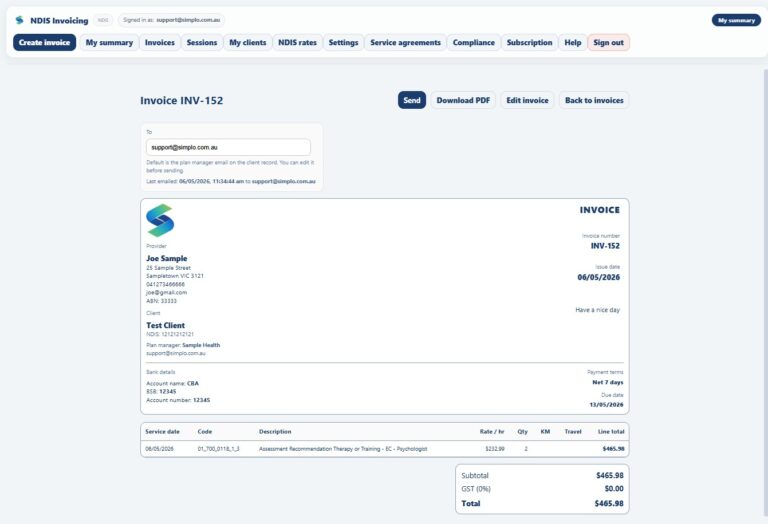
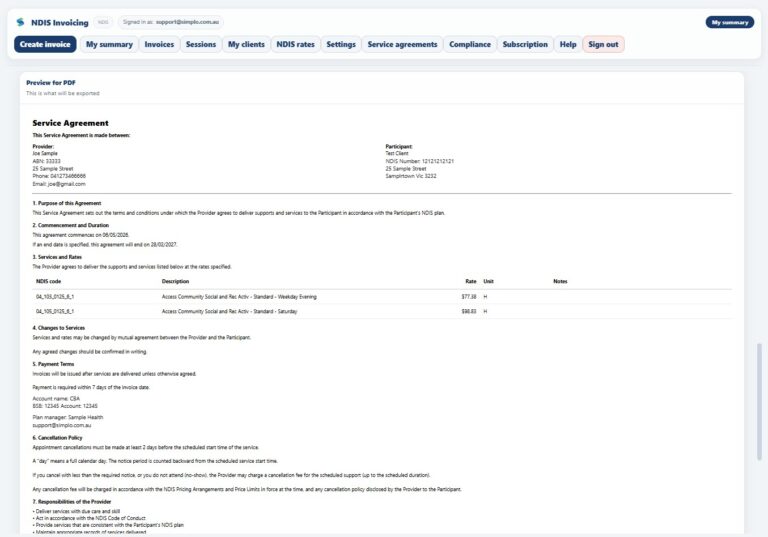
In practical terms, this means every invoice, session record, service delivery note, service agreement, and compliance document needs to be stored in a system that keeps it retrievable for 7 years from the date of the record. Invoices stored only in an email thread, session notes written in a personal diary, and service delivery records kept only in the memory of the worker who delivered the support are not going to satisfy this requirement.
You need a system that organises records by client and date, stores them in a retrievable format, and does not depend on your own memory or the continued existence of a particular email account. The 7-year period also means records from sessions delivered today need to still be accessible in 2033 — worth considering if you are storing things in systems you might not still be using then.
Evidence requirements for payment claims are increasing
The NDIS Amendment Bill 2026 also introduces increased evidence requirements for NDIS payment claims, specifically including evidence at point of service. In plain terms, an invoice alone is no longer sufficient to support a payment claim. There needs to be verifiable evidence that the support described in the invoice was actually delivered.
This formalises a direction the NDIS Quality and Safeguards Commission has been moving in for some time. Auditors and plan managers have increasingly been asking providers to demonstrate service delivery, not just produce invoices. The NDIS Amendment Bill 2026 puts that expectation into law.
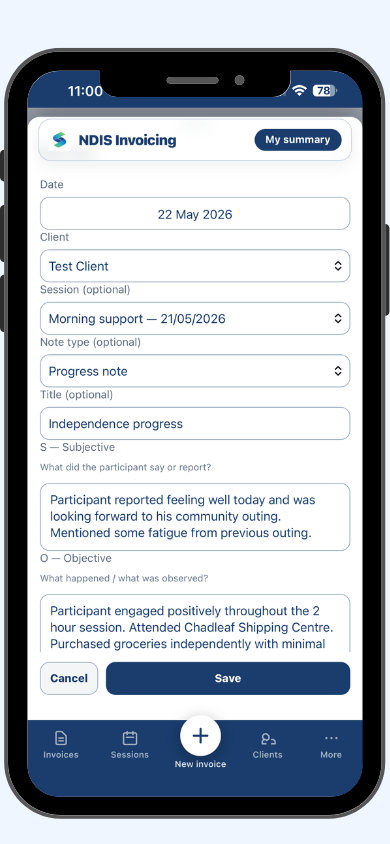
What does adequate evidence look like? The legislation and accompanying guidance consistently point to contemporaneous documentation — notes made at the time of service delivery, not reconstructed afterwards. A timestamped session note, recorded by the support worker at the end of the shift, that describes what support was provided, when, and to whom, is the model. The word contemporaneous matters: a note written the following week from memory carries far less evidentiary weight than one recorded at the time.
For providers already attaching session notes to invoices as a matter of course, this change may not require much adjustment. For providers invoicing without any supporting documentation, the new requirements represent a material change to how payment claims need to be handled going forward.
Simplo Pro and Teams include timestamped session notes that attach directly to invoices as evidence of service delivery. Workers dictate their session note by voice at the end of each shift. The note is timestamped, linked to the session, and can be included on the invoice PDF in one tap. Learn about Simplo Pro →
Mandatory registration is expanding beyond SIL and platform providers
From 1 July 2026, mandatory registration with the NDIS Quality and Safeguards Commission has already commenced for supported independent living providers and NDIS digital platform providers. That first expansion is now underway.
The NDIS Amendment Bill 2026 confirms that mandatory registration will go further, extending to all providers delivering supports to participants who are most at risk of abuse or exploitation. The detailed scope of that broader expansion is still being finalised, but the direction is unambiguous. At the end of 2024, only approximately 8 per cent of the provider market was registered. That proportion is going to increase substantially over the next several years.
What does registration actually require? Meeting the NDIS Practice Standards means having documented policies and procedures, incident and complaint registers, qualifications tracking, compliance document storage, and the ability to produce evidence of compliance on demand. Registration is also not a one-time exercise — registered providers are subject to ongoing audit obligations and must demonstrate continuous compliance, not just compliance at the moment of registration.
If you are currently unregistered and believe you may become subject to mandatory registration under the expanded framework, now is the time to build the infrastructure you will need — not to wait until the commencement date is confirmed. Building a policy library, setting up registers, and getting your compliance documentation in order takes time. Starting the process well before any deadline gives you options; starting after the deadline has been announced does not.
What the NDIS Amendment Bill 2026 means for providers right now
Taken together, the three changes in the Bill push in the same direction: a documented, retrievable, evidence-based record of everything you do as a provider. Invoicing, service delivery, incident management, compliance documents, and policies all need to be in a system that can produce them on demand — and keep them for 7 years.
The providers who will find the transition manageable are those already running their practice through a purpose-built system that keeps records, links evidence to invoices, manages compliance documents, and can export everything when needed. The providers who will struggle are those still operating across a mix of spreadsheets, email threads, Word documents, and handwritten notes.
None of this is a surprise. The direction of NDIS reform has been signalled clearly for two years, through the Independent Review, the Royal Commission, and successive ministerial announcements. What has changed with the passage of this Bill is that it is now law. The expectation is no longer guidance — it is a legal obligation with civil penalties attached.
If your practice infrastructure is not yet in the right shape, this week is as good a time as any to start fixing that.
How Simplo covers these requirements
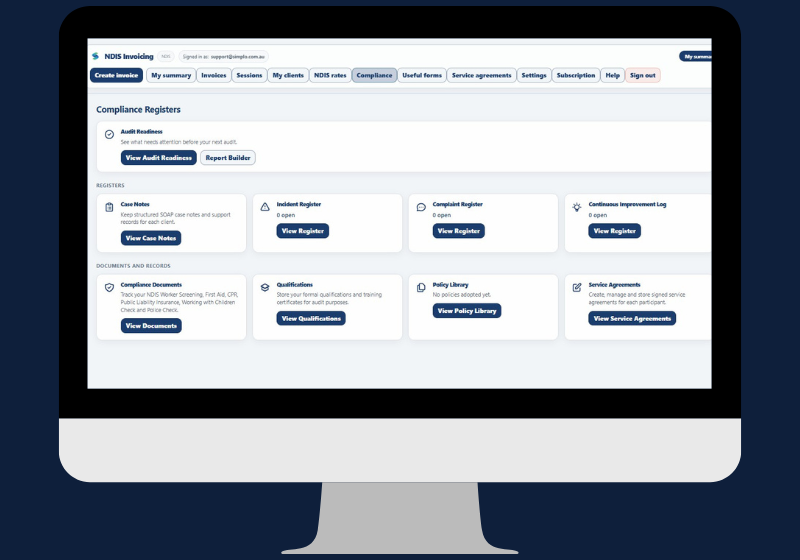
Simplo Pro and Simplo NDIS Teams were built around the record-keeping and evidence requirements that the NDIS Amendment Bill 2026 now formalises. Session notes are timestamped at the moment of recording and can be attached to invoices as evidence of delivery. All records are stored in Australia, linked to the relevant client and session, and exportable on demand. The compliance stack includes incident, complaint, and continuous improvement registers, compliance document and qualification storage with expiry tracking, a policy library with 21 NDIS policies, an audit readiness dashboard, and a one-button audit package export.
The 7-year record keeping obligation is addressed by the nature of how Simplo stores data — records do not disappear when you cancel a subscription, and the full audit export means you leave with everything you created.
Get started
Try Simplo free for 30 days
No credit card required. No lock-in. All records stored in Australia, exportable at any time.
Keep reading
Related articles