
How to Become an NDIS Support Worker in Australia (2026 Guide)
Learning how to become an NDIS support worker in Australia is the first step toward a career that offers genuine flexibility, job security, and meaningful work. The National Disability Insurance Scheme (NDIS) funds support for Australians with permanent and significant disability, and with over 600,000 active participants across the country, the demand for qualified NDIS support workers has never been higher.
What Does an NDIS Support Worker Do?
An NDIS support worker provides practical assistance to people with disability so they can live more independently and participate in their community. The specific tasks vary depending on the participant’s needs and their NDIS plan, but commonly include:
- Personal care — assistance with showering, dressing, and grooming
- Domestic tasks — cleaning, cooking, and household management
- Community access — accompanying participants to appointments, social activities, and outings
- Transport — driving participants to and from activities
- Skill building — supporting participants to develop independence in daily tasks
- Social support — companionship and emotional support
NDIS support workers may work in a participant’s home, in community settings, or in supported accommodation. Shifts can include daytime, evenings, and weekends, and many NDIS support workers choose casual or part-time arrangements to suit their lifestyle.
Do You Need Qualifications to Become an NDIS Support Worker?
Formal qualifications are not legally required to work as an NDIS support worker in Australia. However, the reality is more nuanced than that.
If you are working for a registered NDIS provider, that provider sets its own requirements for the NDIS support workers it engages. Many registered providers require or strongly prefer workers who hold at least a Certificate III in Individual Support (Disability) or equivalent. For roles involving personal care, complex support needs, or clinical tasks, formal qualifications are often expected.
If you are working as an independent NDIS support worker with self-managed or plan-managed participants rather than through a registered provider, you have more flexibility. Many independent NDIS support workers operate without formal qualifications, particularly for social support and community access roles.
The most widely recognised qualifications for NDIS support workers are:
- Certificate III in Individual Support (CHC33021) — the standard entry-level qualification, covering disability, aged care, and home and community settings
- Certificate IV in Disability (CHC43121) — for NDIS support workers who want to take on more complex or specialised roles
- First Aid and CPR certificate — required by most employers, particularly for personal care roles
Important: Even if qualifications are not legally required for your specific role, completing a Certificate III significantly improves your employment prospects as an NDIS support worker, your pay rate under the SCHADS Award, and your ability to work with participants who have complex support needs.
The NDIS Worker Screening Check: What It Is and How to Get It
The NDIS Worker Screening Check is the most important compliance requirement for any NDIS support worker in Australia. It is a national background check that assesses whether a person poses a risk to people with disability.
The check looks at criminal history, workplace misconduct findings, and other relevant information. It is more comprehensive than a standard police check and is specifically designed for roles working with vulnerable people.
Who needs it: The check is mandatory for all NDIS support workers employed in risk-assessed roles by registered NDIS providers. This includes direct support workers, team leaders, coordinators, and key personnel such as managers and directors. For NDIS support workers with unregistered providers or self-managed participants, the check is not legally required — but many participants and platforms now ask for it regardless.
How to apply: You apply through the worker screening unit in the state or territory where you live. The application is done online, and in most states you will need to visit a government service centre to verify your identity in person.
Cost: Fees vary by state. As of mid-2026, approximate costs are:
- NSW — $107
- VIC — $135.50
- QLD — $156
- WA — $145
- SA — $140
- TAS — $133.70
- ACT — $157
- NT — $145
Processing time: Most applications are processed within 2–6 weeks, though complex cases can take longer. Apply early — you cannot start working as an NDIS support worker in a risk-assessed role until your clearance is granted.
Validity: The NDIS Worker Screening Check is valid for 5 years and is recognised nationally. You do not need to reapply if you move states or change employers.
The NDIS Worker Orientation Module: Quality, Safety and You
The NDIS Worker Orientation Module, titled Quality, Safety and You, is a free online training course developed by the NDIS Quality and Safeguards Commission. Every NDIS support worker should complete it — it takes approximately 90 minutes and covers the NDIS Code of Conduct, participant rights, and your responsibilities as a worker.
The module is mandatory for all NDIS support workers employed by registered NDIS providers and is strongly recommended for anyone working in the sector regardless of registration status. Many participants and platforms now ask to see your certificate of completion before engaging an NDIS support worker.
The course covers four areas:
- An introduction to the NDIS and disability in Australia
- The role of the NDIS Quality and Safeguards Commission
- The seven principles of the NDIS Code of Conduct
- Your responsibilities as an NDIS support worker and how to raise concerns
To complete it, go to training.ndiscommission.gov.au, create a free account, and enrol in the Worker Orientation Module. You need to score 80% or higher on the final assessment to receive your certificate. The certificate does not expire.
How to Become an NDIS Support Worker: Step-by-Step
Registered vs Unregistered NDIS Provider: What’s the Difference for Support Workers?
As an NDIS support worker, you can operate in one of two ways: as an employee or contractor of a registered NDIS provider, or as an independent (unregistered) provider working directly with self-managed or plan-managed participants.
Working for a registered provider means the provider is responsible for meeting NDIS quality and safeguard requirements. They handle registration, audits, and compliance. Your Worker Screening Check is mandatory, and you must follow the provider’s policies and procedures. This is the most common starting point for new NDIS support workers.
Working as an independent NDIS support worker means you take on more responsibility yourself. You set your own hours and rates (within NDIS Price Guide limits for plan-managed participants), manage your own invoicing, and are responsible for your own compliance. The Worker Screening Check is not legally required for unregistered roles, but many participants and platforms will still ask for it. You also need your own ABN and must comply with the NDIS Code of Conduct regardless of registration status.
How Much Do NDIS Support Workers Earn in Australia?
Pay rates for NDIS support workers are governed by the Social, Community, Home Care and Disability Services (SCHADS) Industry Award. Rates vary based on your qualification level, the type of shift, and the complexity of support provided.
As a general guide for 2026, an NDIS support worker can expect to earn:
- Standard weekday shifts — approximately $30–$42 per hour
- Evening and Saturday shifts — penalty rates apply, typically 25–50% above base rate
- Sunday and public holiday shifts — higher penalty rates, commonly 100% above base rate
- Annual salary range — $55,000 to $100,000+ depending on hours, shift patterns, and qualifications
Independent NDIS support workers set their own rates, subject to NDIS Price Guide maximums for plan-managed participants. Self-managed participants can agree to any rate with their NDIS support worker directly.
Key Responsibilities of an NDIS Support Worker
All NDIS support workers — registered or unregistered — must comply with the NDIS Code of Conduct. This is a legal requirement, not a suggestion. The Code of Conduct sets out seven obligations every NDIS support worker must follow:
- Act with respect for individual rights to freedom of expression, self-determination, and decision-making
- Respect the privacy of people with disability
- Provide supports and services in a safe and competent manner with care and skill
- Act with integrity, honesty, and transparency
- Promptly raise and act on concerns about matters that may impact quality and safety
- Take all reasonable steps to prevent and respond to violence, exploitation, neglect, and abuse
- Take all reasonable steps to prevent and respond to sexual misconduct
Beyond the Code of Conduct, NDIS support workers are also expected to maintain confidentiality, work within their scope of training (for example, not performing clinical tasks they have not been trained for), and keep accurate records of the supports they deliver.
Invoicing as an Independent NDIS Support Worker
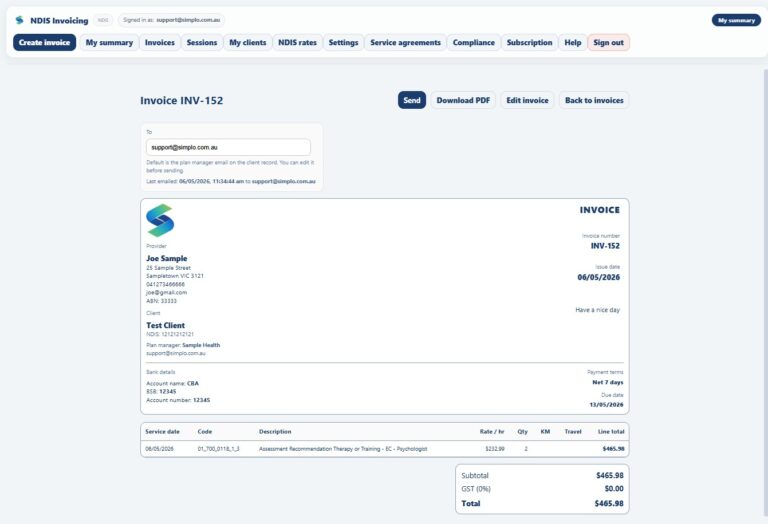
If you work as an independent NDIS support worker with plan-managed or self-managed participants, you are responsible for your own invoicing. This means creating an invoice for each period of work, including the correct NDIS support item codes and rates, and sending it to the plan manager or participant for payment.
Getting invoicing right is important. Incorrect support item codes, missing ABNs, or the wrong rates can result in delayed or rejected payments. Plan managers process a high volume of invoices from NDIS support workers and errors slow everything down.
Common invoicing requirements for NDIS support workers include:
- Your full name or business name and ABN
- The participant’s name and NDIS number
- A unique invoice number and issue date
- The date each support was delivered
- The NDIS support item number and description
- The quantity (hours or units) and unit rate
- Your bank account details for payment
Invoicing Made Simple for NDIS Support Workers
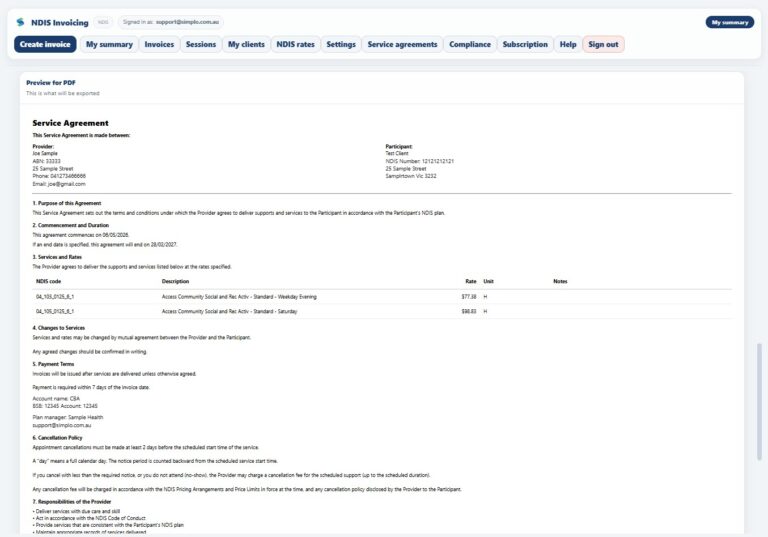
Once you start working with participants, invoicing is one of the first admin tasks you’ll need to get right. Simplo NDIS is built specifically for independent NDIS support workers in Australia. The NDIS price guide is built in, so you select your support items from a searchable list and your invoice is generated automatically with the correct codes and rates — ready to email to the plan manager directly from the app. No spreadsheets, no manual calculations.
Try Simplo free for 30 daysNo credit card required · Works on any device · Cancel anytime