
How Tradies Can Get Paid Faster
Why Getting Paid on Time Is a Problem for Tradies
Cash flow is the lifeblood of any trade business. When clients pay late — or when you delay sending invoices — you end up covering costs out of your own pocket while waiting for money that is already owed to you. Materials, fuel, subcontractors, and your own time all have to be funded somehow in the meantime.
Research from the ATO and various small business groups consistently shows that late payment is one of the top financial stressors for Australian sole traders and small businesses. The average small business invoice in Australia is paid 23 days late. For a tradie running tight margins, that kind of delay has real consequences.
The good news is that understanding how tradies can get paid faster does not require chasing clients aggressively or changing the way you do business. It mostly comes down to removing friction — making it as easy as possible for your client to pay, and as fast as possible for your invoice to reach them.
How Tradies Can Get Paid Faster: 7 Practical Tips
These are the changes that make the biggest difference. Most of them cost nothing and can be put in place today.
The Biggest Reason Tradies Get Paid Late
Delayed invoicing is the number one reason tradies get paid late — not difficult clients. When you finish a job on Friday and send the invoice the following Wednesday, you have already given the client a five-day head start on the payment clock. If your terms are 14 days, you are now waiting nearly three weeks from the day you finished the work.
Same-day invoicing is how tradies can get paid faster without changing anything else. It sounds simple because it is. The challenge is that sending an invoice at the end of a long day on the tools is the last thing most tradies want to do. The fix is making the process fast enough that it is not a burden.
If sending an invoice takes two minutes from your phone, you will do it. If it takes twenty minutes at a laptop, you will put it off. That is why the tool you use matters.
What to Include on Every Invoice to Get Paid Faster
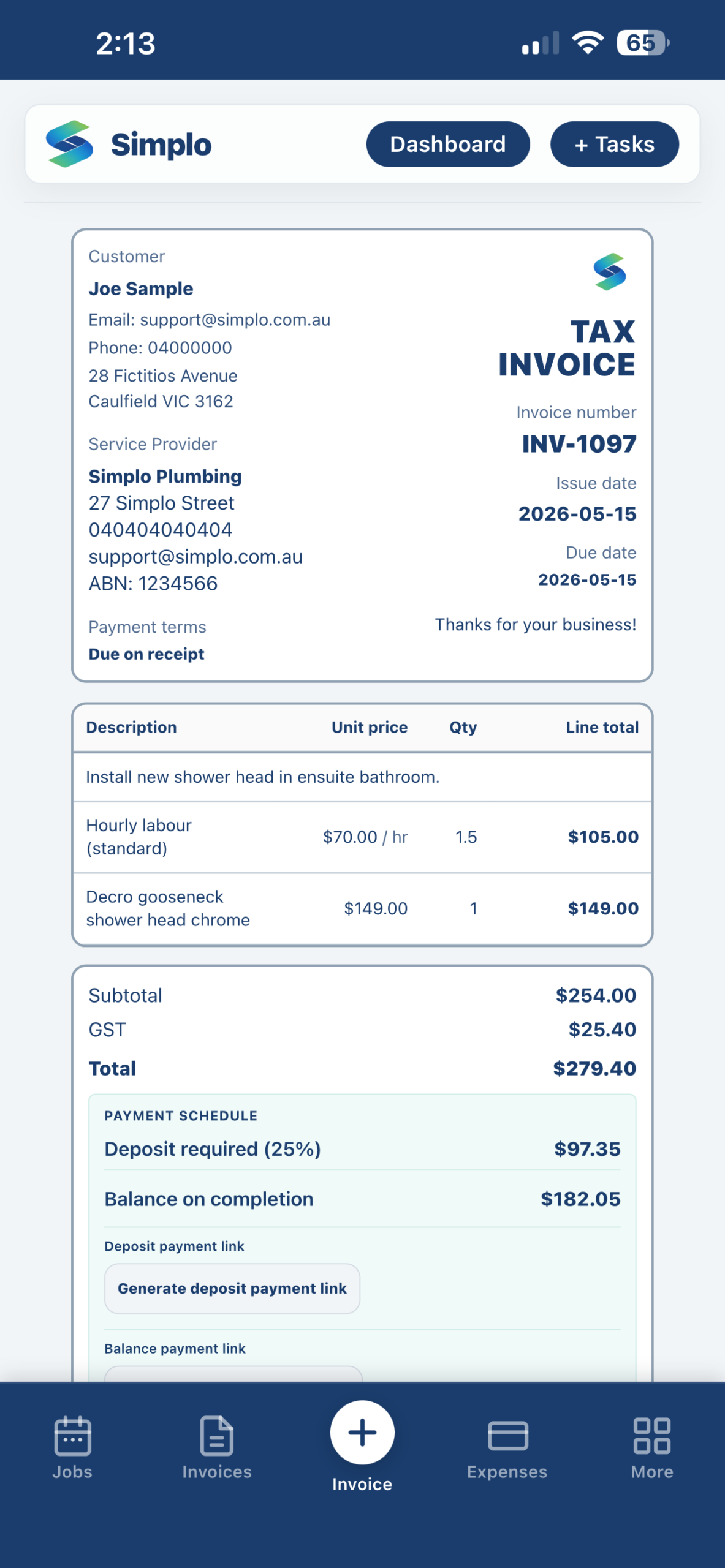
An invoice that is missing information gives the client a reason to delay. Some will contact you to ask for the missing details. Others will just wait. Either way, it slows down payment. Every invoice should include:
- Your full business name and ABN
- The word “Tax Invoice” at the top if you are registered for GST
- A unique invoice number
- The date the invoice was issued
- A clear description of the work completed
- The amount charged, with GST shown separately
- Your payment due date
- Your bank account details or a direct payment link
Missing any of these — especially the due date or payment details — is one of the most common reasons invoices sit unpaid. If a client has to email you to ask for your bank details, that is a delay you could have avoided.
Should You Charge Late Payment Fees?
Late payment fees are legal in Australia and some tradies use them. Whether they are worth it depends on your client base and the type of work you do.
For residential clients — homeowners you might work with once or occasionally — late payment fees can create friction and damage the relationship. A friendly follow-up call or message is usually more effective and less likely to cause bad feeling.
For commercial clients — builders, property managers, real estate companies — late payment fees are more standard and more enforceable. If you regularly work with commercial clients who pay slowly, putting a late payment clause in your terms and conditions is worth considering.
The more practical approach for most tradies is to focus on the steps above — same-day invoicing, payment links, clear terms, and prompt follow-up — rather than relying on fees to recover money after the fact.
How Tradies Can Get Paid Faster With the Right App
The practical reality is that how tradies can get paid faster often comes down to the tools they are using. If your invoicing process is slow or tied to a desktop, same-day invoicing will not happen consistently no matter how good your intentions are.
A good mobile invoicing app should let you:
- Build and send a professional PDF invoice from your phone in under two minutes
- Include a payment link automatically so clients can pay by card immediately
- Set your standard payment terms once and have them appear on every invoice
- Save your labour rates and materials so you are not retyping them every time
- See at a glance which invoices are unpaid and overdue
Simplo is built specifically for Australian tradies and does all of the above. You can send a professional invoice with a Stripe payment link directly from your phone before you leave the job. Clients receive a clean PDF by email and can pay immediately by card. No chasing BSB numbers. No waiting for bank transfers to clear.
Worth knowing: According to Xero’s research, invoices with online payment options are paid an average of 8 days faster than those requiring bank transfer. Adding a payment link to your invoice is one of the highest-impact changes you can make.
A Simple System for Getting Paid on Time
You do not need a complicated process. Here is a straightforward system that works for most sole traders and small crews:
- Before the job: Send a quote with a deposit request for any job over $1,000. State your payment terms clearly.
- Day of completion: Send the invoice from your phone before you leave. Include a payment link. Set a 7-day due date.
- On the due date: If unpaid, send a brief follow-up message. Keep it friendly — most late payments are oversight, not avoidance.
- One week overdue: Follow up again, this time by phone. A direct conversation resolves most outstanding invoices.
- Two weeks overdue: Send a formal overdue notice with your bank details and payment link again. State that you will escalate if not resolved by a specific date.
Most invoices will be paid at step one or two if you are sending them promptly and making it easy to pay. The later steps are rarely needed when the earlier ones are done right.
The Bottom Line on How Tradies Can Get Paid Faster
How tradies can get paid faster is not a mystery. Send your invoice the same day you finish the work. Include a payment link. Set a clear due date. Follow up promptly. Use a tool that makes all of that fast enough to actually do consistently.
The tradies who get paid quickly are not the ones with the most aggressive payment terms — they are the ones who make it easy for clients to pay and do not give them any reason to delay.
Send Invoices From Your Phone in Under Two Minutes
Simplo is built for Australian tradies. Send professional invoices with payment links directly from your phone, on the job. Try it free for 30 days — no credit card required.
Start Your Free TrialNo credit card required · Works on any device · Cancel anytime